Cosmic Frontiers by Science News
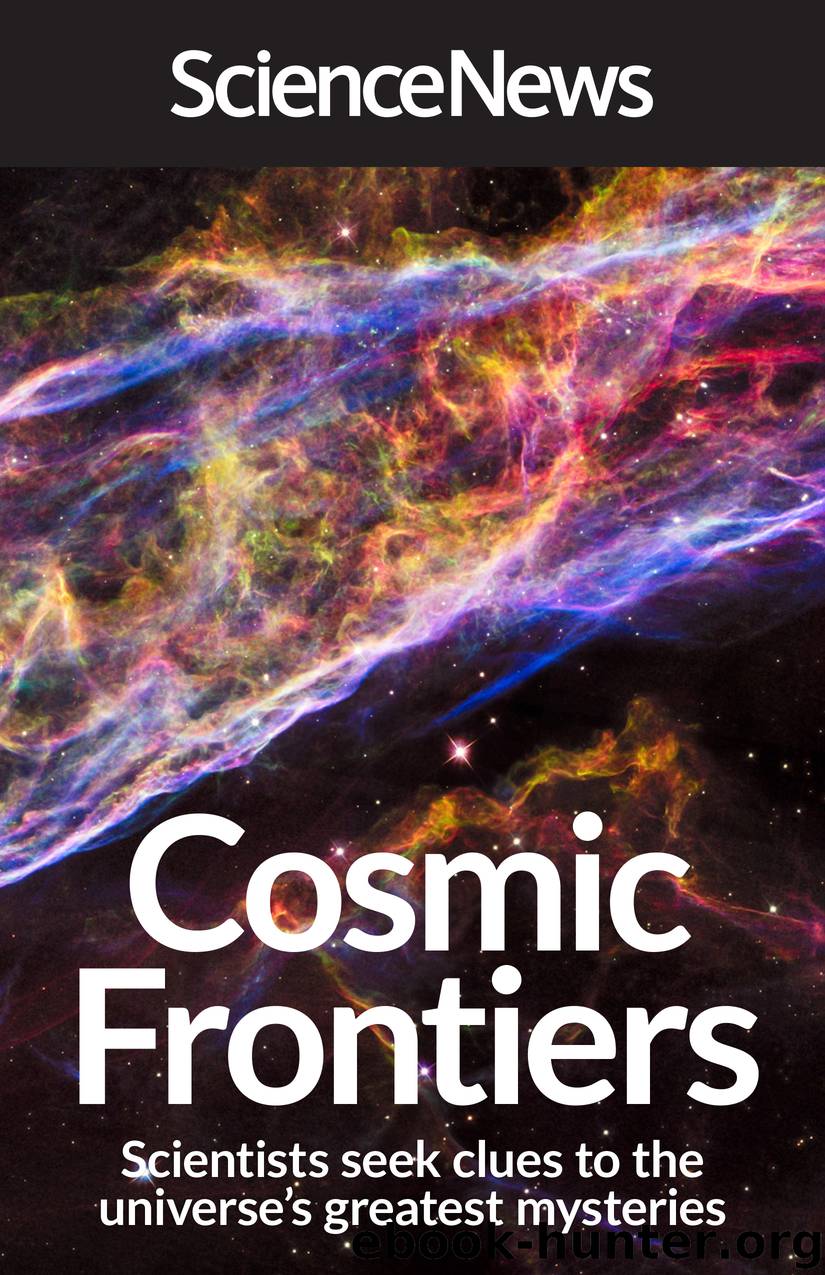
Author:Science News
Language: eng
Format: epub
ISBN: 9781626818446
Publisher: Diversion Books
Published: 2016-08-21T16:00:00+00:00
Scientist says universe is actually exploding
October 10, 1931
The universe is actually exploding and the galaxies are scattering apart at a terrific rate, Sir Arthur Eddington, professor of astronomy at Cambridge University, contended before the British Association for the Advancement of Science hundredth anniversary meeting. In support of his contention he presented computations based solely on pure mathematical and physical theory, without the use of astronomical data. The rate of nebular recession thus obtained is in close accord with Dr. Edwin P. Hubble’s Mt. Wilson Observatory figures for the red shift of nebular spectra.
Prof. Hubble said, “Detailed theories of stellar evolution are overshadowed by the fact that the time scale is again in the melting pot. With a rapid-expansion universe, a very long time scale of billions of years, fashionable recently, becomes exceedingly incongruous. We have to accept an age of ten to the tenth power or ten billion years for galaxies and presumably also for stars.”
Since the age of the earth alone, derived through the radioactive method, is over a billion years this embarrasses astronomers, geologists and biologists. Prof. Eddington derived the actual rate of expansion of the universe from the wave equation for the electron, which is the fundamental equation of the modern quantum theory. This equation, adapted to the curvature of space, contains the term: “the square root of the number of electrons in the universe divided by the radius of the universe in a state of equilibrium,” which term is the mass of the electron, usually written: M•C2/E2.
Combined with the formulae of the relativity theory, this gives the principal data of the size of the universe. Its original radius was 1,070,000,000 light-years, before it started expanding. Its rate of expansion is 528 kilometers per second per megaparsec, compared with 465 derived from the Hubble astronomical data. It is over a hundred miles per second for each million light-years’ distance. “The close accordance of the theory with observation forces acceptance of an alarmingly rapid dispersal of nebulae, with important consequences in limiting the time available for evolution,” Prof. Eddington concluded.
Download
This site does not store any files on its server. We only index and link to content provided by other sites. Please contact the content providers to delete copyright contents if any and email us, we'll remove relevant links or contents immediately.
| Fantasy | Gaming |
| Science Fiction | Writing |
Sita - Warrior of Mithila (Book 2 of the Ram Chandra Series) by Amish(55233)
The Crystal Crypt by Dick Philip K(37035)
Cat's cradle by Kurt Vonnegut(15526)
Ready Player One by Cline Ernest(15112)
Always and Forever, Lara Jean by Jenny Han(15058)
The Last by Hanna Jameson(10372)
Year One by Nora Roberts(9938)
Persepolis Rising by James S. A. Corey(9549)
The remains of the day by Kazuo Ishiguro(9192)
Never let me go by Kazuo Ishiguro(9083)
Red Rising by Pierce Brown(8969)
Dark Space: The Second Trilogy (Books 4-6) (Dark Space Trilogies Book 2) by Jasper T. Scott(8316)
The handmaid's tale by Margaret Atwood(7897)
Frank Herbert's Dune Saga Collection: Books 1 - 6 by Frank Herbert(7316)
The Circle by Dave Eggers(7243)
The Testaments by Margaret Atwood(7076)
Legacy by Ellery Kane(6755)
Pandemic (The Extinction Files Book 1) by A.G. Riddle(6655)
Six Wakes by Mur Lafferty(6392)
